Taking a pet along on an international trip can be a stressful experience, but Condor Airlines has made it as easy as possible. If your dog, cat, or assistance animal is small, you will know the rules beforehand and will be able to travel stress-free with your pet.
In this guide you will understand the insights on pets in the cabin, pets in cargo, fees, documentation, booking tips, and health requirements. Take it step by step so it’s a safe, comfortable, and happy trip.
Why You Should Plan Your Pet’s Travel With Condor in Advance
Traveling with your furry friend is an exciting adventure, but it also needs to be well-prepared. Making your pet’s travel safe, comfortable and stress-free is important, Condor Airlines makes it easier. Planning ahead will not only keep your pet safe but also avoid any last-minute surprises at the airport.
Book Your Pet’s Spot Early
Space on Condor flights is limited for pets (in the cabin). When you book your pet’s travel at the time of your flight confirmation, you can be sure that:
- Your pet sleeps in the cabin or cargo area
- Refraining from full flights where pets might not be allowed
- Additional time to set up special accommodations, if necessary, for Condor
Note: Cabin space for small dogs and cats is limited and will sell out fast so please book early.
Verify Carrier Size, Weight & Airline Rules
Each airline has its own pet carrier policy, and Condor is no exception. Prior to traveling, check:
- Carrier sizes: Must fit under the seat when traveling in the cabin
- Weight restriction: In the cabin the combined weight (pet + carrier) is limited to 8 kg (17 lbs).
- Type: Soft-sided for the cabin, hard-sided and IATA-approved for cargo.
- Special features: Ventilation, secure locks, adequate space for your pet to stand, turn and lie comfortably
You can prepare your pet for the journey and keep your pet safe and comfortable and let the airline know you’ve done so.
Prepare Necessary Documents
Pets need documentation for international travel or even travel domestically. Prepare these ahead of time:
- Vaccination documents (Rabies vaccinations)
- Pet passport for European travel
- Microchip documentation
- The certificate must be issued by a veterinarian and be a health certificate.
Pets may not be able to be boarded if they are not properly documented. Preparation early is useful in saving time, stress, and additional expenses.
Consider Travel Dates & Weather Conditions
Cargo animals are temperature and stress sensitive. In very hot or cold weather, Condor may limit the ability to travel with pets to ensure the safety of the pet.
- Book your flight during cooler times of year or early morning/late evening flights.
- Do not use peak summer/very hot routes to transport cargo
- Take into account layover duration in order to reduce waiting time in the airport
Tip: Make sure to look at the weather forecast for both the origin and destination airports in case of additional delays or restrictions in travel.
Benefits of Planning Ahead
Preparing your pet’s travel offers several benefits:
- Decreases stress for your pet and you
- Responsible for priority handling by Condor staff
- Ensures that last-minute denials do not occur because of paperwork, weight or space limitations
- Provides time to prepare your pet for the carrier and travel procedure
Planning ahead isn’t only convenient; it will make it easier, safer, and more fun for you and your pet to travel.
Pets Allowed on Condor Airlines
Traveling with a pet can be a fun experience, but there are guidelines to be followed for the safety, comfort, and convenience of all on board. Pets can travel on Condor Airlines, depending on the purpose, size and weight of your pet.
Small Dogs and Cats: Cabin Travel
Small dogs and cats are allowed in the cabin with their owner, according to certain criteria set out in Condor’s small dog and cat policy:
- The maximum total weight (pet + carrier) is 8 kg (17 lbs).
- Pets are only allowed in a soft-sided pet carrier at all times.
- Carriers should be approximately 55 x 40 x 20 cm and fit beneath the seat in front of you.
- No pets are allowed in the cabin except one per passenger.
Tip: Cabin pets feel better when comforted and kept close to their owners, and as a result will be less stressed during the flight.
Medium and Large Pets: Cargo Travel
All dogs or animals over a certain size and weight must be carried in Condor’s cargo space. Key points:
- Should be in a hard-sided, IATA-approved container.
- The pet should be able to sit, turn around and get comfortable in the crate.
- Crates should be securely locked, well ventilated and have the owner’s name on the crate.
- Weather-dependent restrictions may be in effect for safety reasons.
Pro Tip: If you are traveling in the summer or very cold weather, make sure your dog is comfy along the way.
Assistance and Guide Dogs
Condor Airlines has special considerations for assistance and guide dogs:
- May be permitted to travel for free
- May be seated with the owner in the cabin (as per airline and aircraft policy).
- To ensure comfort and accessibility, special seating arrangements may be made.
Please remember, Condor will need to be warned of any travel with a guide or service dog in advance to ensure smooth handling and priority boarding.
Important Notes About Condor’s Pet Policy
- Condor continually reviews and updates its policies on pets to meet safety and regulatory requirements.
- Please be aware of the newest regulations before making your booking to avoid any surprises. With advance planning, your pet will have a safe, stress-free, and smooth traveling experience.
Read Also: – EVA Air Pet Travel Policy
Traveling With Pets in the Cabin on Condor Airlines
Flying with your beloved pet in the cabin can be a stress-free and enjoyable experience—if you follow Condor Airlines’ rules carefully. These rules will be developed to provide comfort, safety, and peace of mind for pets and passengers alike.
Cabin Pet Eligibility
Not all pets are allowed in the cabin. The following are allowed on Condor:
- Dogs and cats only are allowed to travel in the cabin.
- The total weight of the pet and carrier should not exceed 8 kg (17 lbs).
- Pets will be transported in a soft-sided, air-permeable carrier which must be kept inside the aircraft during the flight.
Tip: Small pets adjust better to traveling in the cabin, and they are less likely to cause trouble for their fellow travelers.
Carrier Requirements for Cabin Travel
The pet carrier is the crucial element to a hassle-free flight. Condor Airlines requires:
- A soft-sided structure with sufficient ventilation.
- Ensure secure design to keep animals from escaping.
- Should be able to fit below the front seat in front of you
- The size is approximately 55x40x20 cm.
- Interior should provide enough room for your pet to stand, turn around and lie down comfortably.
Pro Tip: If you have one, keep a familiar blanket, toy, or chew in the carrier to help comfort your pet and keep him/her calm.
Cabin Travel Rules
To ensure a smooth cabin experience, Condor will observe the following rules:
- Pets are allowed on board (1 per passenger)
- The pet is required to be calm and quiet throughout the flight
- Carrier to remain under seat during takeoff, landing, and turbulence.
- Passengers are asked to check on pets discreetly to ensure comfort throughout.
Pro Tip: Schedule feeding and bathroom breaks well before boarding. Don’t feed your pet immediately before and during the flight, to reduce stress or discomfort.
Traveling With Pets in the Cargo Hold on Condor Airlines
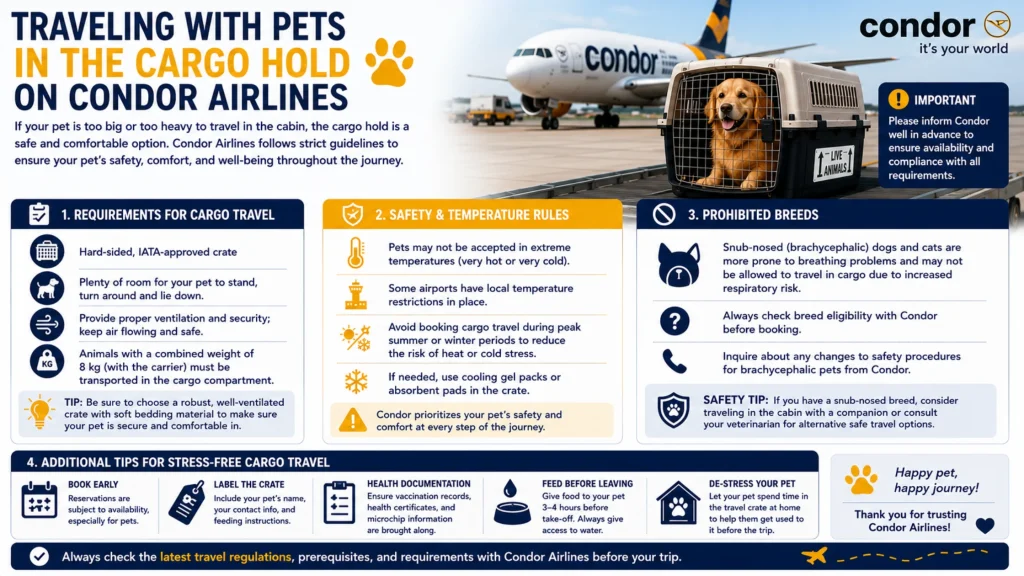
However, if your pet is indeed too big or too heavy to ride in the cabin, you might need to use the trailer. Condor Airlines is pet-friendly and offers to transport pets safely in the cargo hold, but there are specific rules to be followed to ensure the comfort, safety and wellbeing of your pet during the flight.
Requirements for Cargo Travel
If your pet is forced to travel in cargo, Condor’s requirements are:
- Hard-sided, IATA-approved crate
- Plenty of room for your pet to stand, turn around and lie down.
- Provide proper ventilation and security; keep air flowing and safe.
- Animals with a combined weight of 8 kg (with the carrier) must be transported in the cargo compartment.
Tip: Be sure to choose a robust well-ventilated crate with soft bedding material to make sure your pet is secured and comfortable in.
Safety & Temperature Rules
It is a priority at Condor to keep pets safe, especially due to temperature and climate:
- Sometimes, pets may not be able to fly in extreme temperatures either, possibly during hot summers or freezing winters.
- There are some airports where local temperature restrictions are in place.
- Do not schedule cargo travel during the peak summer or winter travel time to reduce heat or cold stress.
- If needed, provide cooling gel packs or absorbent pads for the crate.
Prohibited Breeds
Some breeds are more susceptible to breathing problems in cargo:
- Due to the increased risk of infection in the respiratory tract, snub-nosed (brachycephalic) dogs and cats might not be allowed to travel.
- Be sure to inquire about breed eligibility prior to booking.
- Inquire about any changes to safety procedures for brachycephalic pets from Condor
Safety Tip: For those who have a snub-nosed breed, consider traveling in the cabin with a companion or ask your veterinarian about other ways to get around safely while flying.
Additional Tips for Stress-Free Cargo Travel
- Book early: Reservations are subject to availability, especially for pets:
- Label the crate: Include your pet’s name, your contact info, and feeding instructions
- Health documentation: Ensure that vaccination records, health certificates, and microchip information is brought along.
- Feed before leaving: Give food to pet 3-4 hours before take-off; give water to pet.
- De-stress your pet: Have your pet spend some time in the travel crate at home to de-stress prior to the trip.
Condor Airlines Pet Fees – Cabin & Cargo
Flying with your furry friend carries extra costs, depending on whether you’re flying with them in the cabin or cargo hold and other factors such as size, weight, route, and destination. Be prepared to avoid unexpected delays and make your trip with your pet as easy as possible.
Pets Traveling in the Cabin
If your pet is small enough that it can fly under the seat with you, the approximate fees are:
- One-way €60 – €90 per pet per trip (dependent on route)
- Has soft-sided carrier and supervision on flight by you
- Pets must be in the cabin with one passenger only.
Note: There are only a certain number of spots approved for pets in the cabin. Make reservations in advance to guarantee you have a pet available and don’t get the short straw.
Pets Traveling in Cargo
Pets that are above the approved size guidelines will not be eligible to enter in the main cabin. However, they can be transported in the cargo hold. The fee of the cargo hold can differ based on the size, route, and type of crate.
- €90–€120+ per pet, one-way
- When traveling with pets of a larger size or on a longer flight, it may be necessary to pay an additional fee.
- Only hard-sided IATA-approved crates are required
- During peak travel times, there could be additional surcharges.
How to Book Your Pet’s Flight on Condor Airlines
If you follow these steps carefully, flying with your four-legged friend is a simple process, although a little planning is required. You and your pet will be able to have a stress-free experience because you have prepared ahead.
Contact Condor Right After Booking
Book flights and reserve your pet’s seat together. Pets must be reserved in advance, as there is a limited number of spots for pets in the cabin. Filling out the airline’s form prior to travel ensures you get the right crate and handling for cargo.
Please note: If your flight is full, if you book early, you may be able to avoid your pet being placed on the next available flight, as early may cause last-minute disruption.
Check Documentation Requirements
Ensure you have all the required paperwork in place prior to traveling:
- Vaccination records—evidence of good health and up-to-date vaccinations.
- Any microchip documentation, which is frequently needed to comply with electronic identification mandates for international travel
- Educating the public about the consequences of traveling with pets who are not fit to fly. Health certificate – a veterinarian’s statement that pets are safe to travel.
- Passport for pets for travel in Europe.
Prepare the Carrier
Your pet carrier will be your pet’s room in the air and preparation is the key:
- Ensure that the carrier is a suitable size, well vented and safe for Condor.
- Pets in the cabin areas must be in a soft-sided carrier, while cargo must be transported in a hard-sided, IATA-approved carrier.
- Make sure that your pet has ample room to rest, turn and lie down comfortably.
Tip: It’s good for your pet to have something familiar and comfy to help them feel more secure and relaxed during the flight.
Arrive Early at the Airport
Pet check-in is recommended 2-3 hours prior to departure. This gives sufficient opportunity for:
- Traveling to and from the airport (check-in and boarding)
- Security screening
- Handling and storage of pets in cabin or cargo
So early arrival not only helps to reduce stress for you, but it also helps to reduce stress for your pet and will help to process smoothly.
Pro Tip: Do not feed your pet prior to the flight and avoid having them use the bathroom, as it may make them feel uncomfortable or cause motion sickness. A few minutes before the airport, a walk helps to defuse your pet too.
Important Health Requirements for Pets Traveling on Condor Airlines
Taking a pet on a flight isn’t all about booking a spot; it’s also about ensuring that your furry mate is healthy, secure, and traveling-ready. In addition, Condor Airlines has health requirements that will make both you and your pet(s) feel at ease throughout the flight.
Up-to-Date Vaccinations
Make sure that your pet’s immunizations are up-to-date, including rabies—most destinations require it. Bring vaccination paperwork with you (paper or electronic). Some countries also may call for extra vaccines for international travel, depending upon where you’re going, so make sure to check the country’s policies.
Tip: Make sure to visit the vet 2-3 weeks prior to your trip so that recent vaccinations will be effective and for updated health paperwork.
Minimum Age Requirement
Pets are not allowed to fly until they are at least 8-12 weeks old. Young animals are more susceptible to stress and sickness, and airlines limit travel due to safety.
Vet Clearance for Air Travel
Have a health certificate or fitness to fly issued by a licensed veterinarian. The certificate will be a confirmation that your pet is not suffering from contagious diseases and healthy and fit to travel. Condor might ask for this certificate, particularly for pets traveling in cargo and pets in the cabin.
Note: Remember to keep the vet certificate for the next 10 days after flight; some airlines have an older certificate as a criterion.
Destination-Specific Entry Requirements
There are individual pet import policies among countries, including the requirement for vaccination certificates, microchipping, quarantine, etc. Be sure that your pet fulfills all the requirements of your arrival country to ensure that you will not be denied entry or quarantined. Destination within the EU may require a pet passport, others may contact embassy or government websites.
Assistance & Guide Dogs on Condor Airlines
In most situations, Condor Airlines will make sure that passengers who use an assistive device or guide dog can travel safely, comfortably, and without additional costs. These highly trained animals are invaluable to travelers, and Condor has their best interests in mind and makes flying as hassle-free as possible.
Free Travel for Service Animals
Condor Airlines does not charge a fee from the passenger if they have to bring an assistance dog on the flight. This policy is applicable to a dog trained for use by a passenger with a disability who has a mobility, visual, hearing, or other impairment. Please make space reservations for your service animal with Condor in advance.
Pro Tip: If you get Condor’s attention early, they can board accordingly and make sure your dog has any additional support he/she might require.
Priority Boarding & Support
Priority boarding is available for passengers traveling with a guide dog. It can help you to get settled into your dog’s bed and to keep your dog secure until the cabin becomes full. Cabin space is designed to allow your dog to be near you and protected from all strangers, thus decreasing stress during flight.
Required Documentation & Certification
When traveling with an assistance dog, please bring the following:
- Evidence of training or certification of your service animal.
- Health and vaccination records
- ID tags or harness (as applicable)
Tip: When checking in (particularly when traveling abroad), having all documents at hand is recommended, as requirements may differ in each country.
International Travel Considerations
The rules that apply to service animals could vary from country to country. In certain countries further health papers and/or microchipping or quarantine may be required. Please check all requirements before boarding to ensure there are no restrictions or delays.
Traveling on Connecting Flights With Pets on Condor Airlines
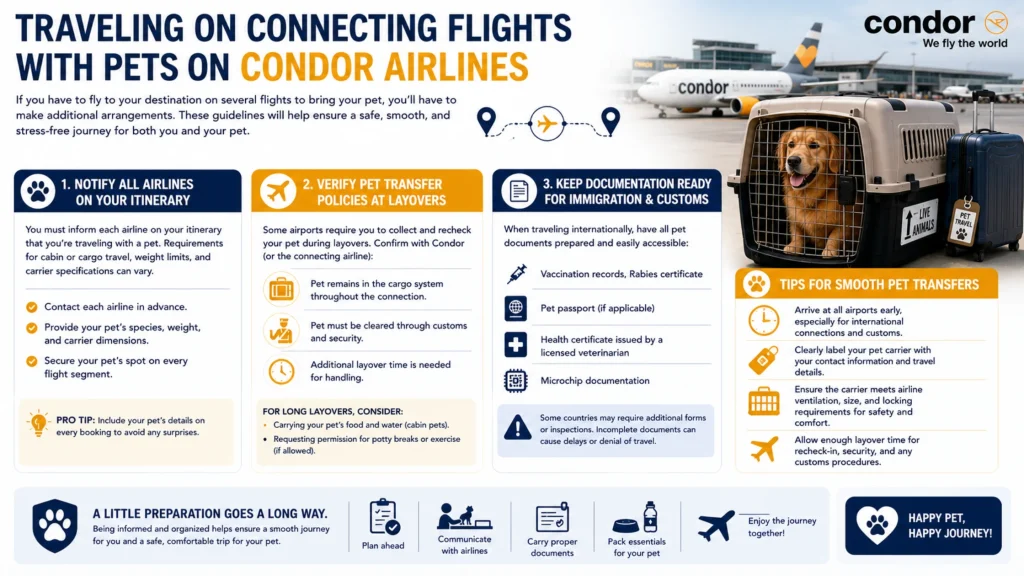
If you have to fly to your destination on several flights to bring your pet, you’ll have to make additional arrangements. Condor Airlines wants you and your pet to have a safe, smooth, and stress-free flight. These are some guidelines that can make a difference whether you are on the move in Europe or internationally.
Notify All Airlines on Your Itinerary
Notify each airline if you are traveling on connecting flights; you will have to tell each airline you are traveling with about your pet. The specific conditions for cabin or cargo travel, weight limits and carrier specifications may vary from airline to airline. Advance notice is important to keep your pet’s place at all points on the way.
Pro Tip: Make sure to put your pet’s information (species, weight, and dimensions of carrier) on every airline booking, in case you have any surprises.
Verify Pet Transfer Policies at layovers
Certain airports will ask you to collect and recheck pets on layovers. Discuss with Condor (or connecting airline):
- All the remains are automatically placed in the cargo system.
- Needs to go through customs and security checks
- Needs additional layover time to manage
To use for long layovers, try:
- Taking the pet’s water or food with them (for pets in cabins)
- Asking to use the toilet or have a short break for exercise as needed (as long as permitted)
Keep Documentation Ready for Immigration & Customs
When traveling abroad, make sure pet documents are well prepared and readily available:
- Vaccination records, Rabies certificate
- Pet passport (if applicable)
- A licensed veterinarian should issue a health certificate for the animal.
- Microchip documentation
Prepare additional forms or be subjected to inspection at airports in certain countries or be delayed.
Tips for Smooth Pet Transfers
Arrive at all airports early, especially at airports for onward travel to customs. Make sure to mark your pet carrier with your contact information and travel plans. When traveling with a crate, make sure that the crate locks and ventilation are up to the standards of the airline and that comfort is provided. Take short layover times seriously—give sufficient time for rechecking / handling.
Read Also: – Avianca Pet Policy
Emergency & Special Considerations for Pets on Condor Airlines
Bringing pets along isn’t always easy, particularly for pets with medical issues, special equipment or sensitive conditions. No matter the circumstances, Condor Airlines will let you know how to keep your pet safe and comfortable.
Animals suffering from medical conditions
If an animal has a medical condition, it is important to have a medical certificate from your veterinarian stating
- Current health status
- Fitness to fly
- The owner must bring the medication for the pets
Condor may ask for this at check-in or on arrival at the airport to guarantee safe travel. Such as pets with heart disease or breath disorders or pets following surgery.
Pro Tip: Take a copy of your vet’s certificate with you both digitally and physically.
Electric or Battery-Powered Mobility Devices
A battery-powered carrier or electric mobility device is required for pets and must be declared in advance. Provide the following details:
- The battery type (gel, lithium-ion, or dry cell)
- Use of suitable handling and transport methods.
With proper labeling, your pet’s carrier can be used safely, particularly in cargo holds.
Safety Note: Lithium batteries can have further airline restrictions—please check with Condor before traveling on an aircraft.
Temperature-Sensitive or Special Handling Pets
Certain pets might need a controlled temperature environment, such as:
- Exotic pets
- Snub-nosed breeds that are susceptible to heat stress.
- Animals with medical or physical conditions that make them vulnerable, such as young or elderly pets
Condor may restrict travel in hot and cold conditions for the welfare of your pet. Many airports have restrictions on temperature-sensitive cargo, so be sure to verify temperature requirements for take-off and landing airports.
Additional Safety Tips
- Plan for layovers: Do not be exposed to extreme weather during layovers.
- Hydration & comfort: For long-haul flights, make sure to use absorbent bedding and ventilate the crate.
- Emergency contacts: Do not forget to include your vet’s number and any directions for your flight with you to give to employees should they need advice.
Conclusion
Condor Airlines is a full-service airline, providing an option for travelling with your pet, and has all the necessary procedures in place to ensure that animals are kept safe, comfortable and healthy on their flights. Careful consideration and documentation is required when planning and providing car seat arrangements for small dogs and cats in the cabin, larger dogs or cats in the cargo area and service and assistance animals.
Condor’s guidelines call for the carriers to be small enough to manipulate, not too heavy, provided with a health certificate, be vaccinated, and any handling requirements be addressed. This airline has been focused on policies related to priority boarding, cargo safety and handling practices for temperature-sensitive cargo. With proper preparation, early booking, and communication with Condor, it is safe, comfortable and fun for the entire family to travel with their pet..
FAQs – Condor Pet Policy
Small pets, such as cats and dogs are allowed in the cabin with Condor. If your pet is under the size and weight restrictions, it may be brought along. Must remain in an approved pet carrier during the flight.
Yes, Condor is a pet-friendly airline. It has clear guidelines if anyone wishes to bring pets with them. The airline offers you a choice on whether you bring your pet along on the flight or in the cargo. For every mode of transportation, there are safety measures to take. Only a certain number of pets are allowed on each flight on Condor. This makes the journey pleasant for everyone and pets.
Condor only allows individuals to travel with dogs and cats. No other animals are allowed, such as a rabbit, bird, or reptile. These are not allowed in the cabin or in the hold.
Yes, Condor allows the large dogs but they cannot travel in the cargo. Such dogs must travel in the cargo hold.
Yes, Condor limit the number of carrier to one for each passenger, but a carrier can accommodate two pets if there is enough space available for two pets.
Read More –